Survey delivery, from the surveyor to the client
A survey firm publishes a release, delivers it to a client organisation, and the client reviews and downloads it in a browser. Delivery and download activity is recorded on both sides.
The sequence
Prepare the survey
Upload the delivery file to a project. It is identified by its leading bytes rather than by its name, checked against the validator for that format, and refused at intake if it is not one of the accepted formats.
Publish a versioned release
A release is a numbered snapshot with a checksum. Once published it never changes: a correction is a new release that supersedes the previous one.
Deliver to a client organisation
You name the receiving organisation by the code it gives you, choose how long access should last, and write a short message. A cooling period follows — a day by default — in which you can still withdraw.
The client reviews and downloads
They open the release in a browser, and download the files as one archive or one at a time. Each download is recorded, and a receipt is written when every file has arrived.
What files work
GeoJSON and ASCII DXF become map layers a client can open and measure. ZIP archives, uncompressed LAS point clouds and PDF documents are accepted and kept for download, and are not drawn on the map. Nothing else is accepted as a delivery today.
What the recipient needs
- A GISweaver organisation of their own, on any plan including the free one. There is no guest link, no token and no address that grants access on its own.
- No installation and no desktop software. They sign in to the same web application you do, in an ordinary browser.
- Their organisation code, which they read off their own settings page and give to you. You name them by that code, and their organisation name is shown to you before anything is sent.
- An organisation on the same deployment. A delivery does not cross from one regional cell to another.
Who pays
- The surveyor. The delivered files stay on the sending organisation and count against its storage until it retires them, and sending is available on every published plan.
- Receiving is free. It uses none of the receiving organisation’s storage, and nothing on the receiving side is refused because of the plan the client is on, except copying the release into an account of their own.
- Extending an access window is free, and can be done as often as the surveyor needs.
Old versions never change
A published release is frozen in the database itself. A correction is issued as a new release that marks the previous one superseded, so the version a client reviewed in March is still exactly what they reviewed in March.
How the files are downloaded
- As one archive with a manifest listing every file and its checksum, or one file at a time by name.
- Through the application, under the recipient’s own sign-in. There is no shared link and no pre-signed address: the storage location never appears on the wire.
- A download is refused, with the reason, if the release has been retired, the cooling period has not passed, the sending organisation is suspended, the delivery has been withdrawn or revoked, or the window has ended.
What the receipt records
A receipt is written when every file in the delivery has reached the receiving organisation, and is stored on both sides. An interrupted download leaves the record of an attempt and no receipt, which is the truth of what happened.
It names:
- the two organisations, by identifier and legal name, and no individual person
- the project label, and the release with the date it was published and its checksum
- every file handed over, with its size and its SHA-256 checksum, and whether it left as an archive or on its own
- the moment the last file completed, and a coarse network class — domestic, foreign or unknown — never an address
It is signed by the deployment, so either organisation can show it to a third party without asking us to confirm anything.
A receipt is a record of delivery and download activity. It is not a certification of the survey itself: whether the survey is correct, complete and fit for its purpose remains the responsibility of the organisation that published it.
What the client sees
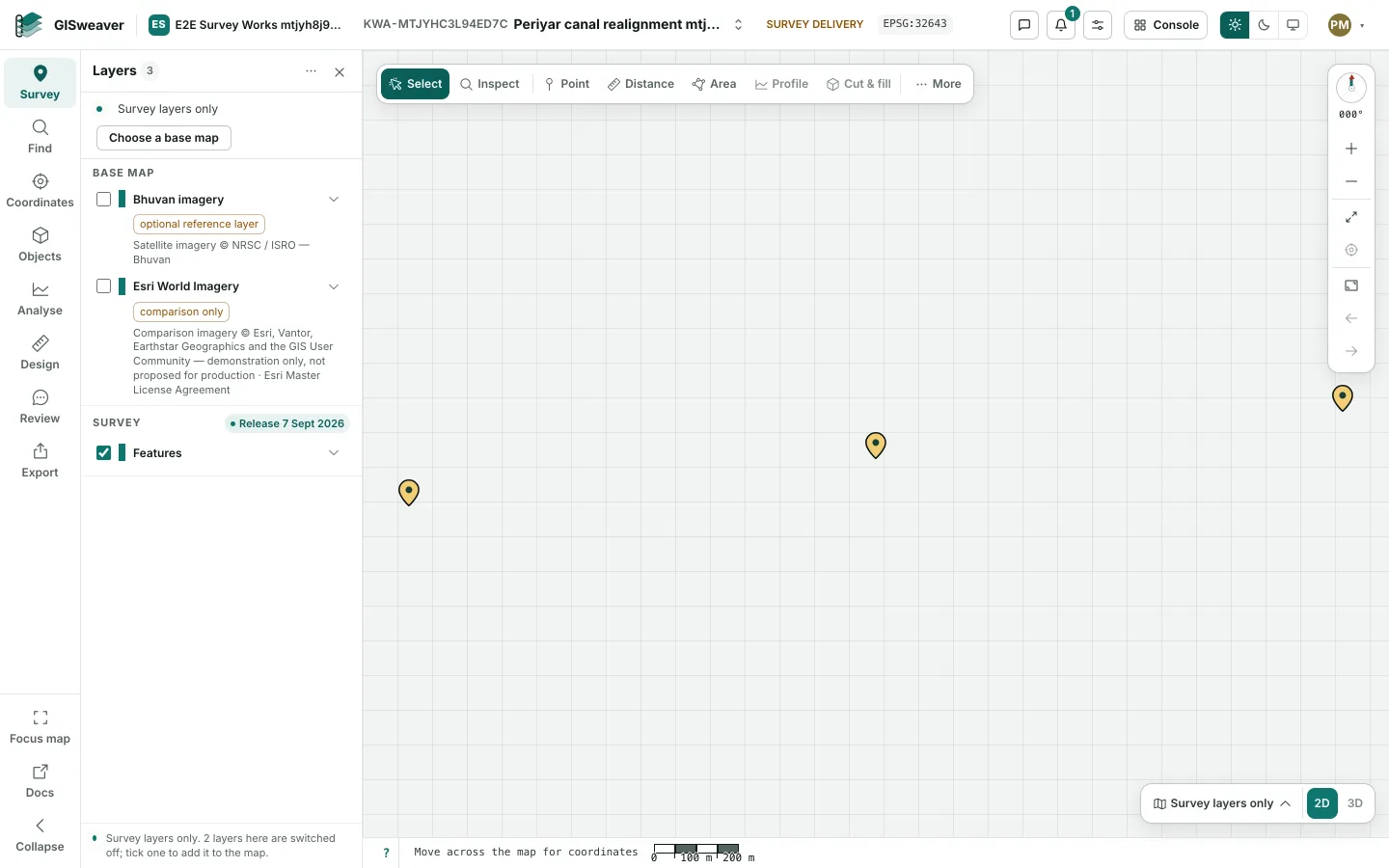
A published release open in a browser: the survey layers and the release they belong to on the left, the measurement tools across the top, and the project’s own coordinate system named in the bar.
When access ends
The surveyor sets the window. It defaults to one year, may be up to two years when the delivery is made, and can be extended free of charge at any time, each extension setting a new end no more than a year ahead.
When the window ends the client stops being able to download. The receipt is kept on both sides for as long as Alonstech operates the Platform, and a client who wants to keep the files on GISweaver copies them into their own account before then.
Ready to look at the product?
The plans page lists what each plan includes and what it costs. If you would rather ask a person first, the support page is the way to reach one.